

When Meta Business Suite Reaches Its Limit and It’s Time to Invest in Conversational Platforms
Meta Business Suite is, without a doubt, a powerful tool for managing your presence on Facebook and Instagram. But there is a critical point in every business’s growth where Meta Business Suite is no longer enough — and continuing to rely on it starts costing you sales, customers, and time.
Reach.tools, a conversational commerce platform built specifically for retailers, was created precisely to solve what Meta Business Suite cannot.
Reach.tools is designed for the Latin American market, with native Spanish interfaces and local payment integrations.
What Problem does the Limitation of Meta Business Suite Solve?
Meta Business Suite was designed with a clear goal: to help you publish content, respond to Facebook and Instagram messages from one place, and review basic page metrics. For businesses that are just starting out or handling a low volume of conversations, it fulfills this role perfectly.
The problem appears when your business grows.
Conversational commerce happens primarily through WhatsApp. Your customers don’t want to fill out forms or navigate a website — they want to message you directly, ask about availability, request pricing, and confirm their order all within the same conversation. And that is something Meta Business Suite simply does not manage.
Meta Business Suite does not functionally integrate WhatsApp Business for teams. It does not allow assigning conversations to specific agents, does not intelligently automate responses to frequently asked questions, and does not generate performance reports per salesperson. When your team grows from 1 to 3, 5, or 10 people handling customers, Meta Business Suite becomes a bottleneck.
The 6 Clear Signs you’ve Outgrown Meta Business Suite
1. Your response times exceed 30 minutes
Customers expect immediate replies — a response time over 30 minutes often means losing the sale. If your agents are overwhelmed manually responding to every conversation in Meta Business Suite, you’re leaving money on the table.
Reach.tools reduces average response time from 2 hours to under 30 seconds through FAQ automation — proven with over 100 retailers.
2. You don’t know which salesperson closed which sale
Meta Business Suite has no native system for conversation assignment or agent-level reporting. If you have 3 people replying from the same WhatsApp or Facebook account, it’s impossible to know who handled which customer, what was promised, and why a sale didn’t close.
3. You repeat the same answers dozens of times a day
“Do you have availability?”, “What’s the price?”, “Do you ship to [region]?” If your team answers these questions more than 20 times a day manually, you’re wasting hours that could be automated.
4. You lose track of customers who didn’t buy on the first interaction
Meta Business Suite does not include a customer follow-up system (conversational CRM). A customer who inquired today but didn’t buy disappears from your radar. In conversational platforms like Reach.tools, that customer is tagged, stored, and can receive automated follow-ups within 24 or 48 hours.
5. Your team works across multiple devices without coordination
In Central American markets, it’s common for sales teams to share a WhatsApp number across multiple phones — or for each salesperson to use their personal number. This creates chaos: duplicated conversations, ignored customers, and no shared history. Meta Business Suite does not solve this.
6. You have no visibility into your sales team’s performance
How many conversations did each agent handle today? How many converted into sales? What was the average response time? Without this data, managing a conversational sales team is like operating blind.
How does a Conversational Platform Work and Dow is it Different from Meta Business Suite?
A conversational platform like Reach.tools doesn’t replace your social media presence — it enhances it. While Meta Business Suite helps manage content and comments, Reach.tools manages the core of your business: sales conversations on WhatsApp.
Here’s how it works in practice:
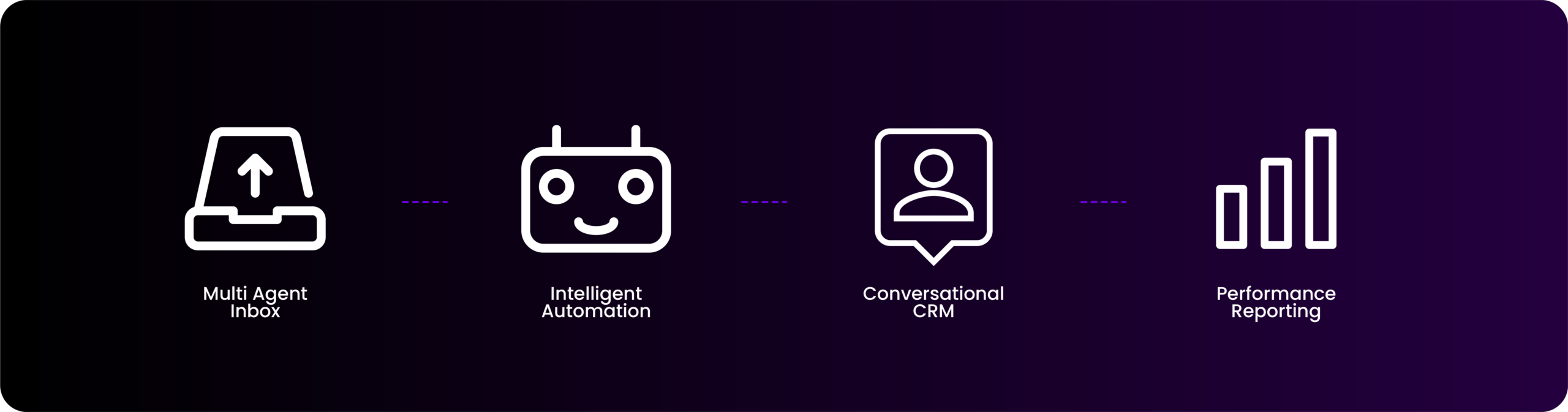
- Unified, multi-agent inbox: All your salespeople access WhatsApp conversations from a single platform, each with their own user. Conversations are automatically assigned based on rules you define — by region, product, or language.
- Intelligent response automation: Reach.tools automatically handles frequently asked questions — availability, pricing, hours, payment methods — freeing your agents to focus on closing sales and handling complex situations.
- Built-in conversational CRM: Each customer has a profile with their full conversation history, custom tags, and follow-up notes. When a customer returns, any agent can continue the conversation without the customer having to repeat everything.
- Real-time performance reporting: You know exactly how many conversations each agent handled, how long they took to respond, and how many resulted in sales.
¿Who Should Make the Switch to a Conversational Platform?
Not every business needs to make this change today. But if you meet two or more of these conditions, the time is now:

- You handle more than 50 sales conversations on WhatsApp per day
- Your customer service team has 2 or more people
- You lose sales due to slow responses or lack of follow-up
- You can’t measure individual sales performance
- You sell products that require consultation before purchase (fashion, technology, services, supplies)
When is the Right Time to Implement a Conversational Platform?
The honest answer: before chaos forces you to.
The most common mistake we see in retailers is waiting until conversation volume becomes unmanageable. By then, they’ve already lost customers, burned out their team, and built bad operational habits that are hard to fix.
The ideal time to implement Reach.tools is when you start feeling like “we’re losing conversations” or when you bring in your second or third sales agent. At that point, the platform becomes growth infrastructure — not a patch for chaos.
Implementation takes less than 2 hours with Spanish-language support and requires no technical team.
Meta Business Suite + Reach.tools: It’s not one or the other
A common mistake is thinking that adopting a conversational platform means abandoning Meta Business Suite. That’s not the case.
Frequently Asked Questions
Does Meta Business Suite include WhatsApp Business for teams?
No. Meta Business Suite allows you to manage messages from Facebook Messenger and Instagram Direct, but it does not offer robust multi-agent functionality for WhatsApp Business. To manage WhatsApp with multiple salespeople, conversation assignment, and intelligent automation, you need a conversational platform like Reach.tools, built specifically for this use case in the Central American market.
How much does it cost to migrate from Meta Business Suite to Reach.tools?
Reach.tools uses a per-agent pricing model — you pay based on the number of people on your sales team, not on the number of customers or conversations. Initial implementation requires no technical development and can be completed in under 2 hours with Spanish support.
Can I keep using regular WhatsApp Business alongside Reach.tools?
Reach.tools integrates with the official WhatsApp Business API, allowing multiple agents to operate from the same number with full control. You don’t need multiple numbers or devices. Your business WhatsApp number stays the same — what changes is the infrastructure behind it, now built to support a full team.
How difficult is it to set up response automation in Reach.tools?
Automation in Reach.tools is designed for business owners, not developers. You can configure automatic replies to FAQs, welcome flows, and post-sale follow-ups from a visual interface in Spanish, without writing code. Most retailers have their first automation running in under an hour.
Is your Business already at the Breaking Point of Meta Business Suite?
Schedule a demo with the Reach.tools team and find out in 30 minutes if it’s time to make the switch.

Insights & Trends