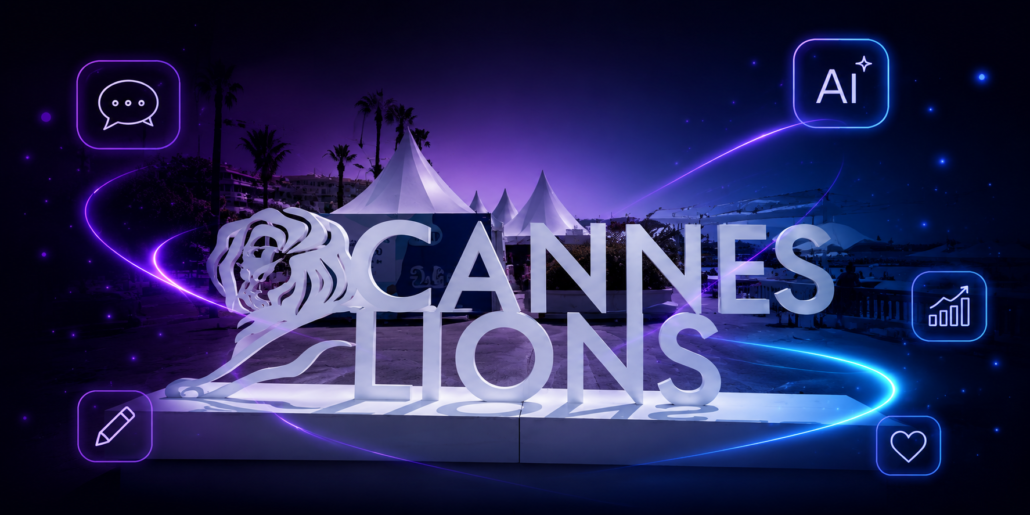

Cannes Lions 2026: Trust Is the New Currency for Brands
I was standing at the Amazon Port, one of the activation spaces at Cannes Lions, listening to someone from WPP explain how they measure whether an AI recommends your brand over your competitor’s. I didn’t ask “how do I make a more creative ad?” I asked “how do I get the AI to recommend me?” That was the first sign this Cannes Lions was going to be different from every one before it.
I spent four days moving through activations at Amazon Port, Canva, TikTok, Salesforce, LinkedIn, Microsoft, Pinterest, and Meta. Eight stops in four days. But one conversation kept repeating at every single one: artificial intelligence isn’t a tool you use anymore — it’s an actor whose trust you have to earn, the same way you’d earn a person’s.
If you sell anything in Latin America, this matters more than you think. While we’re still debating whether it’s worth automating your business’s WhatsApp, the conversation at Cannes was already three steps ahead: what happens when the one deciding what your customer buys isn’t your customer — it’s the AI agent representing them?

AI isn‘t a Tool Anymore, it’s the New Decision Layer
At the Amazon Port, Charlotte Maines talked about something called Share of Answer: the metric for whether AI actively recommends your brand when someone asks it what to buy. It’s not SEO. It’s not paid placement. It’s earning the trust of an agent that decides for your customer before your customer decides for themselves.
But — and this is what almost everyone misses — no amount of AI optimization replaces a genuine brand built over time. Brand equity stopped being a purely creative asset. It’s now a technical one too: the data, the reputation, and the consistency behind your brand are literally what the AI reads to decide whether to recommend you.
Microsoft made the same point from a different angle. At Microsoft Gardens, they walked through how AI agents are redefining the entire funnel: they search, compare, and decide on your customer’s behalf, and based on behavior and timing, the agent pushes ads and recommendations all the way to close. The buying journey isn’t linear anymore. It’s one agent talking to another, and your brand needs to be the answer that agent prefers to give.
The Human Connection Can’t be Automated, it Gets Amplified
If that last point makes it sound like everything is turning into machines, the Canva stand was the necessary counterweight. They showed us how to design pieces using Claude inside Canva — faster, better, with less friction. But the message underneath wasn’t “let AI design for you.” It was that technology powers the work, and people make the connection.
LinkedIn brought that same idea into the daily operation of a team. Their advice wasn’t “put AI in everything.” It was the opposite: choose deliberately where it actually adds value, build curiosity into every team, and make sure no one gets left behind without AI amplifying their work. AI amplifies what you’re already doing well. It doesn’t fix what you’re doing badly, and it doesn’t replace what only a human can give.
Pinterest made the point without saying a word of strategy: instead of giving talks, they built experiences. It was an uncomfortable, necessary reminder — brands aren’t here just to sell. We’re here to create moments people remember. No AI generates that for you.
The Future of Selling is Live, and the Customer Comes First
TikTok was maybe the most concrete stop of the eight. Live Shopping isn’t a trend anymore — according to them, it’s the future of selling: selling live, inside the same conversation where your customer is already consuming content.
That’s not as far from what we already do in Central America over WhatsApp as it might sound. Selling inside the conversation, without ever pulling the customer out of the channel they’re already in, is exactly the principle behind conversational commerce.
Salesforce put the priorities in the right order: customer first, agent second. Before you build any AI agent, do a deep briefing — how your customer thinks, what they ask, how they like to receive information. Trust is still essential: the customer has to trust the agent enough to let it help them. And here’s a warning almost nobody’s paying attention to: SEO still matters. Keep feeding it, keep a strong community around it, and keep making things easy for the customer while staying relevant.
Meta closed the loop with a live demo that generated an entire campaign — images, copy, targeting, even the publish — in minutes. But the most telling detail wasn’t the automation. It was this: the brands selling the most use an influencer or reference figure the audience trusts so much, people end up buying the person, not just the product.
The Synthesis: Four Things that Repeated at Every Stop
After eight different activations, with eight different marketing messages, four ideas kept surfacing, nobody stated them directly, but every brand confirmed them:

Trust is the new currency. You have to earn it from people and, now, from the AI agents representing them too.

AI amplifies, it doesn’t replace. The human element is still the differentiator. Warmth can’t be automated.

The funnel is being rewritten. Agents search, compare, and decide. If you’re not relevant to them, you don’t even make it into the conversation.

Experiences are what people remember. The most powerful thing is still the moment that makes someone feel something — no AI generates that for you.
How We’re Applying this at Reach
I didn’t leave Cannes with abstract ideas. I left with a concrete list of what changes in how we build Reach:
- Agents built from the customer, not the technology. Before automating any support, we do the deep consumer briefing first — how they think, what they need, how they prefer to be spoken to.
- Sell in chat, and sell live. Conversation plus Live Shopping, without ever pulling the customer out of the channel they’re already in — WhatsApp or otherwise.
- Win the Share of Answer. Structure product data so that when someone asks an AI what to buy, the answer is Reach.
- Warmth plus automation, never one instead of the other. Human support in Spanish that AI powers — never replaces.
- Become a TikTok Marketing Partner. We already have access to start the process; the next step is the Marketing Technology badge.
- Curious teams. Empower every team with AI wherever it genuinely helps — no less, and no more than that.
What I Brought Back
Cannes Lions has always sold itself as the stage for advertising creativity. This year felt different. It felt like the place where the entire world is asking the same question we ask ourselves at Reach every day: how do you build a brand that people trust — and now, that the machines speaking on their behalf trust too?
The answer I heard eight times, at eight different stands, was always the same. You earn it the way you always earned it. With consistency, with humanity, and with the discipline not to automate the one thing that was never meant to be automated.
Insights & Trends