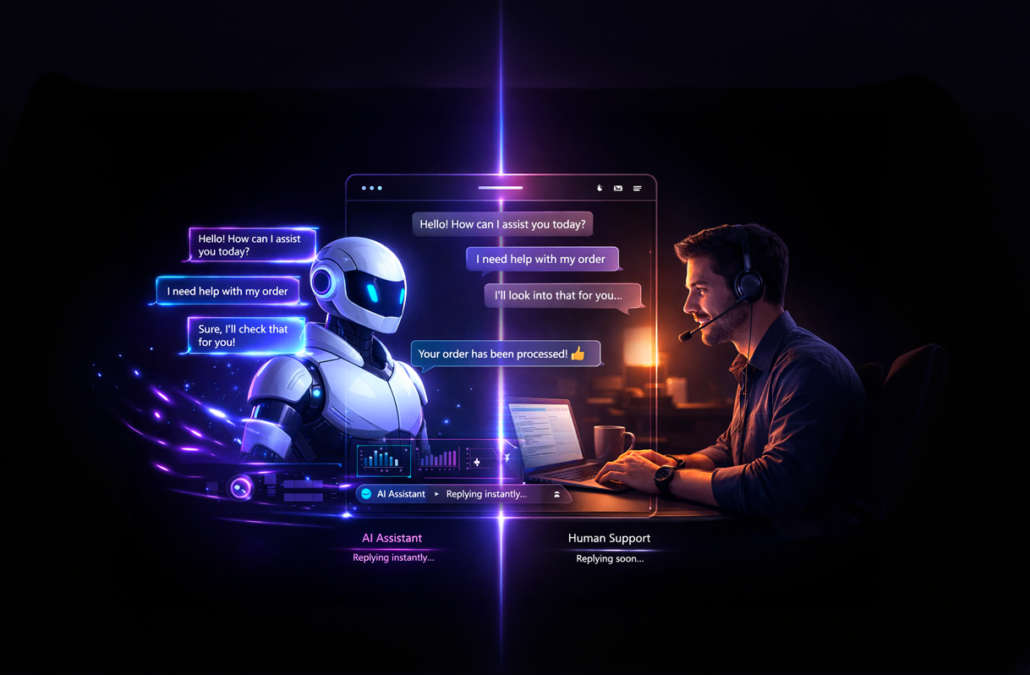

The Bot That Replies in 3 Seconds vs. the Human Who Replies in 3 Hours — Who Wins and Who Loses
When we talk about chatbot vs. human in customer service, many companies believe they must choose between speed and empathy. But the reality is often much more complex.
It’s 9:17 PM. A customer sees your jacket on Instagram, likes it, and messages you on WhatsApp asking if you have a medium in stock.
The bot replies in 3 seconds: “Hi there! Thanks for reaching out. How can we help you today?”
The customer specifies: the jacket, medium, the blue one.
The bot replies with a menu of options. The customer picks “product inquiry.” The bot asks for a reference number. The customer doesn’t have one. The bot says it can’t proceed without it. The customer closes WhatsApp. Ten minutes later, they buy from a competitor who handled it differently.
The bot replied in 3 seconds. You lost the sale anyway.
Now flip it. That same customer, different business, messages at 2 PM. No reply. Your team is at lunch, then in a meeting. At 5 PM the response finally comes: “Hi! Yes, we have that size. Want us to hold it for you?”
The customer bought somewhere else three hours ago.
Two different failures. One diagnosis: the bot–human combination is broken.
The Wrong Question
Most businesses approach customer service automation asking the wrong question: bot or human?
It’s the wrong question because it assumes a choice exists. It doesn’t.
The right question is when to use each one — and what happens at the handoff between the two.
A bot that replies in 3 seconds with the wrong message doesn’t beat a human who takes 3 hours. Both lose. Speed without context is noise. Empathy without availability is a broken promise.
What wins is a system that understands which problem it’s solving at each moment.
What the Numbers Actually Say
There’s a data point that every e-commerce sales team knows but few have actually operationalized: response time is the most predictable conversion variable in messaging channels.
Research on messaging commerce behavior consistently shows that conversion rates drop more than 80% when response time exceeds 5 minutes. Not 5 hours. Five minutes.
The customer who messages at 9 PM isn’t willing to wait until you open tomorrow morning. They’re in decision mode right now — and that mode has a short shelf life.
But that same customer who gets an instant generic response doesn’t convert either. Because speed without relevance creates a different kind of friction: the customer feels processed, not helped.
This is where many businesses get stuck. They deploy a bot to solve the speed problem — and discover they’ve created a quality problem. They turn the bot off and go back to humans — and the speed problem returns.
The cycle repeats until someone realizes that bots and humans aren’t substitutes. They’re complements. And like any functional team, the key is the right division of labor.
What the Bot Wins. What the Human Wins.
Let’s be precise, because confusion here is the root cause of most failed implementations.
The bot wins on volume, speed, and consistency.
- 24/7 availability. Instant responses whether it’s 3 AM or a peak Saturday afternoon.
- Handling hundreds of simultaneous conversations without quality degradation.
- Data capture, intent qualification, order confirmations, shipment tracking — all at a scale no human team can match.
In Latin American markets, where over 90% of internet users are active on WhatsApp and message spikes happen outside business hours, this availability isn’t just a tactical advantage. It’s a survival condition.
The human wins on complexity, empathy, and judgment.
- The furious customer who received a damaged order.
- The product question that requires understanding personal use context.
- The corporate account negotiation.
- The loyal customer who wants to talk to someone, not a system.
These conversations don’t scale well with bots. Not because the technology is poor, but because the customer is looking for something the technology can’t provide: certainty that there’s a person on the other side who understands their specific situation.
The most expensive mistake isn’t choosing wrong between bot and human. It’s deploying one where the other should be.
The Model That Works

The chatbot vs. human debate in customer service is not about choosing one or the other.
The right architecture isn’t bot-first or human-first. It’s bot-until — and human-from.
Here’s how it works.

The bot handles the first layer: greeting, intent capture, and basic qualification. What do you need? Is this a product question, an order issue, or something that requires specialized attention?
This layer resolves 60–70% of any retail or e-commerce business’s inquiries — frequently asked questions, order statuses, catalog information, and availability checks.
When the inquiry is standard, the bot closes it alone. Fast, accurate, no friction.
When it isn’t, it escalates.
And here’s the detail most businesses underestimate: the quality of the escalation determines whether the customer feels well served or bounced around.
A good escalation carries the full conversation history to the human agent. Not “let me transfer you to a specialist” and start over from scratch.

The agent receives the context: what the customer asked, what the bot answered, and where it got stuck.
The agent enters mid‑conversation, not at the beginning.
That difference — escalating with context versus escalating without it — is what separates customers who stay from customers who leave.
The human closes what the bot can’t.
Complex conversations, high‑value customers, and situations that require judgment. And when they close, they can trigger automated follow‑up flows: a satisfaction survey, a confirmation message, or a next‑order reminder.
The loop completes.
Why This Matters More in Markets Where Teams Are Lean
Businesses across Latin America — and frankly, many growing businesses everywhere — operate with a reality that most automation playbooks don’t account for: small teams, multiple active channels, and customers who expect the immediacy of a text message with the warmth of a local shop.
A retail owner managing WhatsApp, Instagram, Messenger, and TikTok with a two‑person team can’t afford to solve this manually. But they also can’t afford a bot that frustrates customers on the first message.
The answer isn’t more technology or more people. It’s smarter distribution of work between both.
The businesses getting this right share a common thread: they don’t think of the bot as a substitute for their agents. They think of it as the first layer of a system — one that guarantees no conversation goes unanswered, and that every conversation requiring a human reaches the right human with the right context.
What You Can Do This Week
You don’t need to redesign your entire service system. You need an honest audit of where the breaking points are.
Review your last 50 conversations that didn’t convert.
- Did the bot reply but not resolve?
- Did the human resolve but arrive too late?
- Was the handoff so poor that the customer ran out of patience?
That answer will tell you exactly which part of the system is failing.
Define what the bot should close on its own — not “frequently asked questions” in the abstract, but your business’s actual frequent questions with your actual answers.
Design the handoff before it matters.
- What does the agent receive when the bot escalates?
- Do they have the conversation history?
- Do they know why it escalated?
If the handoff is broken, the customer feels it even if no one on your team notices.
Measure human response time after escalation. Not the bot’s response time — that’s easy. Measure the actual time between when the bot escalates and when a human picks the conversation back up.
If it exceeds 5 minutes during business hours, you have a staffing design problem, not a technology problem.
Your Customer Isn’t Choosing Between Your Bot and Your Human
They’re choosing between you and your competitor.
A bot that replies in 3 seconds wins when it’s resolving something it can actually resolve well.
A human who replies in 3 hours loses every time — regardless of how good the answer is.
But the system that combines both — with clarity about when each applies and handoffs that preserve context — that system converts.
Not because it has more technology, but because it understands that the customer on the other side of the message isn’t evaluating whether they’re talking to a bot or a human.
They’re evaluating whether they’re talking to someone who can help them.
Insights & Trends