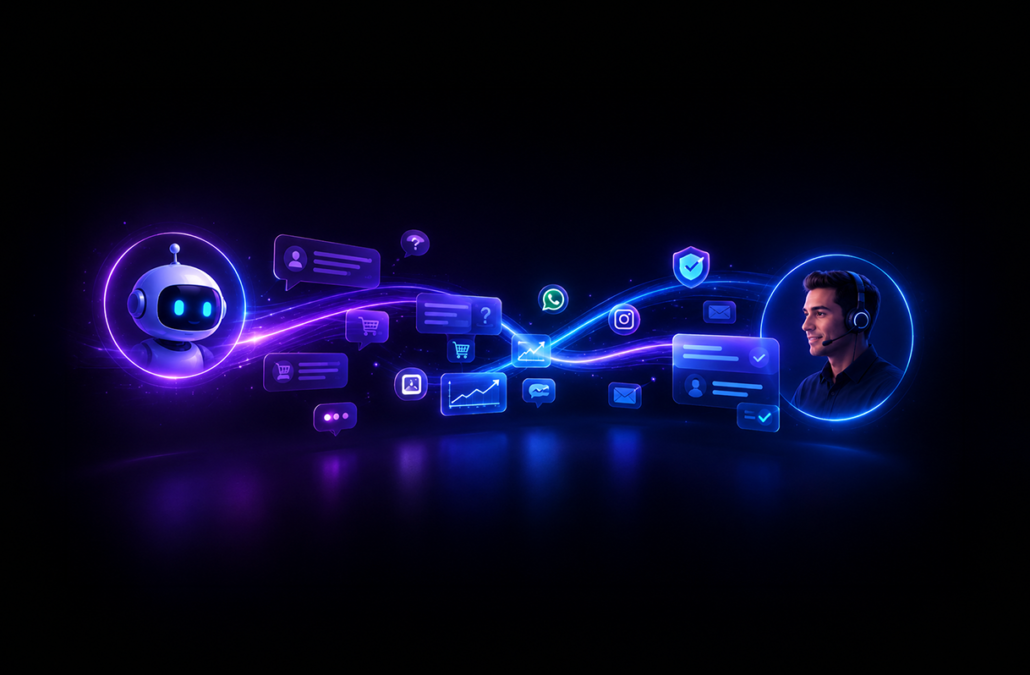

When the Bot Should Step Aside
The conversation was going well.
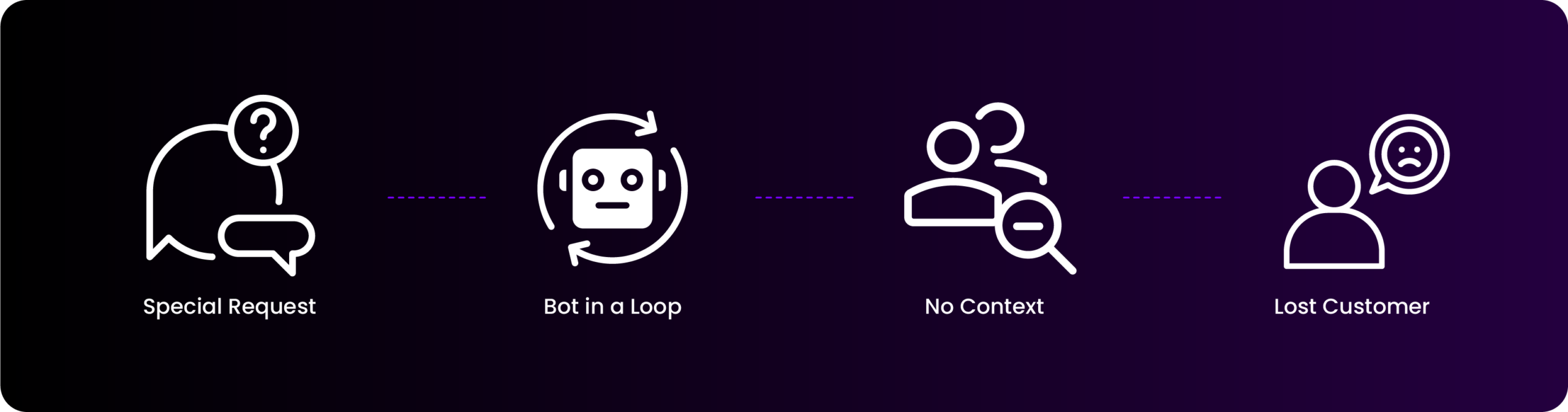
The customer asked about availability. The bot answered. Asked about pricing. The bot answered. Then came the question that wasn’t in the flow – a special request, a complaint, an edge case – and the bot did the only thing it knows how to do when it doesn’t understand: it repeated the menu.
The customer picked the closest option. The bot asked again. Three loops later, someone from the team picked up the chat – no history, no context, no idea what had already been said.
“Hi there, how can I help you today?”
The customer was already gone.
This isn’t a bot problem. It’s a design problem. The bot did what it could. Nobody decided when it should stop – or what should happen next.
The Bot isn’t the Problem. The Handoff is.
A well-configured bot handles roughly 70% of incoming conversations: FAQs, order confirmations, hours, availability, lead qualification. Within that range, it does the work of three people without breaking a sweat.
The problem lives in the other 30% – and it exists because nobody designed for it.
A bad escalation comes in three versions, and all three destroy trust:
The bot that doesn’t realize it’s lost. It keeps serving generic responses while the customer has spent four messages getting nowhere. The conversation dies without anyone noticing.
The bot that transfers without context. The human agent opens a cold chat. The customer has to explain everything from scratch. Friction doubles at exactly the wrong moment.
The bot that transfers to no one. The customer waits. The chat sits in limbo. Nobody comes.
Any one of these does more damage than not having a bot at all.
The Signals That Tell You it’s Time to Escalate
There’s no universal rule. But there are five signals that shouldn’t go unnoticed.
1. The Customer Expresses Frustration
“You’re not understanding me.” “I want to talk to a real person.” “This isn’t working.” When a customer uses that language, the bot shouldn’t respond with another menu option. It should acknowledge the frustration and connect them with an agent immediately.
A frustrated customer who reaches a human is still recoverable. One who hits another bot screen is not.
2. The Same Question Repeats Without Resolution
If a customer asks the same thing twice without the bot resolving it, the flow is broken. That’s an automatic escalation trigger. Putting them through a third loop only accelerates their exit.
3. The Issue is High-Value or High-Risk
A formal complaint, a return, a large purchase, an urgent situation. These cases need a human – not because a bot can’t provide information, but because customers expect judgment and empathy when something actually matters to them.
4. The Customer Asks Directly
The most obvious signal and the most ignored one. If the customer says “I want to speak to someone,” give them that. No screening questions, no one more attempt at automated resolution. A bot that keeps trying to help after being told it can’t turns frustration into rejection.
5. The Bot Hits The Edge of its Training
Every bot has a boundary – the type of question it wasn’t built for. When it responds with something unrelated to what the customer asked, the next move is to escalate. Not to try another variation of the same flow.
How to Hand Off Without Losing the Customer
Knowing when to escalate is half the work. Execution is the other half.
Step 1: Say something. Don’t disappear.
Silence is the worst companion to waiting. The moment the bot transfers the conversation, the customer needs to know two things: that they’re being transferred, and that someone is on the way.
“Got it. Let me connect you with one of our team members – they’re available now and will have the full history of our conversation.”
That one message does three things: it validates what the customer experienced, sets a clear expectation, and removes the anxiety of not knowing what happens next.
Step 2: Transfer with full context.
This is where most teams fall short. An agent who picks up a cold chat can’t deliver good service – regardless of how experienced they are. They start at a disadvantage.
When the handoff is done right, the agent arrives knowing what the customer asked, how many times they asked it, what the bot said, and where it failed. With that context, they pick up the conversation where it left off – not from zero.
Reach transfers the full conversation history to the agent at the moment of escalation. The human opens the chat already knowing everything. The customer doesn’t repeat a word.
Step 3: The agent shows they read it.
The difference between a handoff that builds loyalty and one that disappoints comes down to the agent’s first sentence.

“Hi there, how can I help you today?”

“Hi – I can see you were asking about your order from Tuesday. Let me pull that up right now.”
One sentence changes everything. The customer stops feeling like they started over and starts feeling like someone finally listened.
Step 4: Don’t force the bot to do more than it can.
It’s tempting to configure the bot to try harder before escalating – it reduces load on the human team, or so the logic goes. And it works, up to a point.
But when a customer is already frustrated, every additional bot attempt makes things worse. The cost of escalating early is far lower than the cost of losing the customer.
The Mistakes You Need to Avoid
Turning the handoff into a form. If the customer has to answer four verification questions before reaching a human, you didn’t design an escalation – you designed a filter. Frustrated customers don’t have patience for that.
“Your inquiry has been sent to our team” doesn’t build confidence. The customer needs to know a real person is looking at their conversation – not that they’ve entered an invisible line.
Leaving the bot active after escalating. Once a human agent is in the chat, the bot should step back. Two voices in one conversation create confusion – and the customer doesn’t know who to listen to.
When the Conversation Just Continues
The goal isn’t for the customer to see the handoff. It’s for them not to notice it at all.
When it’s designed well, the conversation simply continues. The tone shifts slightly – more nuance, more flexibility – but the thread doesn’t break. The customer doesn’t repeat themselves. Trust doesn’t get interrupted.
Automation doesn’t replace people. It frees them for the work only they can do: resolving the complex, handling the emotional, closing what matters.
The bot that knows when to step aside isn’t a weak bot. It’s the bot that does its job right.
Want to see how Reach handles escalation with full conversation context – so customers never have to repeat themselves? Request a demo and we’ll show you how it works in your own flows.
Insights & Trends