

Every Business Is a Subscription Business Now—Here’s What That Means for Yours
The Day Salesforce Nearly Died: Why Customer Success Matters (Even If You’re Not a Tech Company)
It’s 2005. Salesforce is exploding. New customers flood in daily. Sales teams crush their quotas. Everyone’s celebrating.
Then David Dempsey walks into an executive meeting with a single slide. His nickname at the company from that day on? “Dr. Doom.”
“We’re dying,” he says.
The room goes silent. Dying? They’re adding thousands of customers. Revenue is soaring. How is that dying?
Dempsey points to one number: 8% monthly churn. They’re losing almost their entire customer base every year. It doesn’t matter how many new customers walk through the front door if existing ones stream out the back just as fast.
This moment in history gave birth to Customer Success as a business discipline.
Here’s what most CEOs miss: This isn’t just a SaaS problem. The same shift is remaking every business right now—including yours.
The Power Shifted (And It’s Not Coming Back)
The old model was simple. Sell a product, collect payment, move on. The customer owned what they bought. You got paid upfront. The transaction ended at the sale.
The subscription economy flipped this completely. Now the sale is just the starting line.
Think about Netflix. When they charge you $15.99 this month, they haven’t “made the sale.” They have to earn that money again next month. And the month after. Every single month, you’re choosing to stay or leave.
This transferred all the power from seller to buyer.
But here’s the insight most business owners miss: You don’t need to be a tech company to live in the subscription economy. You already do.
That customer who comes to your restaurant every Friday? That’s a subscription. They’re renewing their decision every week.
The client who uses your services year after year? Subscription.
The regular at your coffee shop? Subscription.
You are already in the subscription business. The question is are you managing your business like it?
The Math That Changes Everything
Make this concrete. You own a gym. You sign up 100 new members in January. Great! But 8 members cancel each month. By December, you’ve lost 96 members. You’re starting from scratch every year, pouring money into acquisition just to replace losses.
Now reduce cancellations to 2% monthly. Suddenly you keep 76 of those original members after a year. That’s not a small improvement. It’s the difference between surviving and thriving.
This is why the Salesforce story matters to everyone. You can’t outrun churn by acquiring more customers. You have to fix the leak.
What Customer Success Actually Means
Most people think Customer Success is fancy customer service.
It’s not.

Customer service is reactive. Someone calls with a problem. You fix it. Important, but defensive.
Customer Success is proactive. You ensure customers achieve their goals before they realize they need help.
Here’s the difference:

Customer Service: A customer calls because they can’t figure out a feature. Your support team walks them through it. Problem solved.
Customer Success: Your team notices a customer hasn’t logged in for two weeks. They reach out first: “Hey, we noticed you haven’t used the reporting feature. It’s actually the most powerful tool for someone in your role. Want a quick call? We can show you how it saves about five hours a week.”
One fixes problems. The other prevents them and drives value.
Why Only One Type of Loyalty Matters
Most businesses confuse two types of loyalty:
Behavioral loyalty: Customers stay because switching hurts. They’re trapped, not loyal.
Attitudinal loyalty: Customers stay because they love what you do. They’d recommend you to others.
In the old economy, behavioral loyalty worked. High switching costs locked customers in even when they were unhappy.
Today? Every competitor is a Google search away. If you’re relying on friction to keep customers, you’re building on sand.
The only sustainable loyalty is attitudinal loyalty. And you can’t buy it. You earn it, consistently, over time.
Think about Apple’s Genius Bar. That’s not just repairs. It’s Customer Success. They help you extract more value from your iPhone, which makes you love the brand, which makes you buy more Apple products, which makes you tell your friends. It’s a flywheel.
Three Principles for Any Business
Whether you run enterprise software or a family restaurant, these principles will transform how you think about customers:
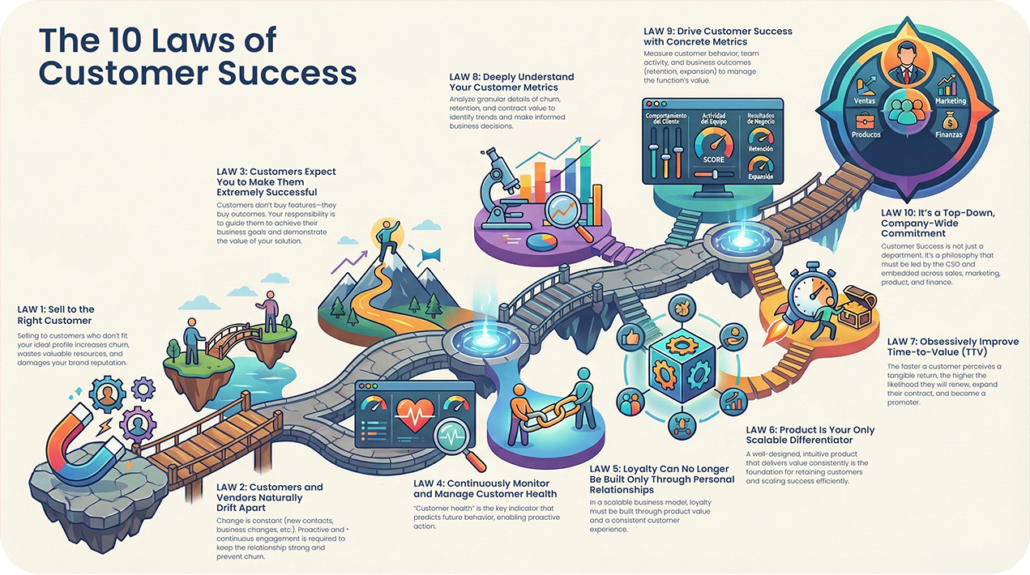
Principle 1: Success Starts at the Sale
Stop selling to customers who aren’t a good fit. I know—revenue is revenue, right?
Wrong.
A bad-fit customer is worse than no customer. They’ll churn, demand excessive support, leave bad reviews, and drain your team’s energy.
Salesforce learned this painfully. They needed to sell to the right customer, not just any customer.
Same for you. That difficult client who doesn’t value your work? Fire them. Or at least stop chasing more like them.
Principle 2: Customer Health Is Your Real Pipeline
You need systems to measure customer health before they churn. By the time a customer tells you they’re leaving, it’s too late.
What does “health” mean for your business?
For SaaS: login frequency and feature adoption.
For a restaurant: visit frequency and average check size.
For consulting: project satisfaction scores and expansion conversations.
Define it. Measure it. Act on it.
Principle 3: Your Experience Must Scale Loyalty
You can’t build a big business on personal relationships alone. Eventually, the experience itself must create loyalty.
This is where most brick-and-mortar businesses struggle. They think success is about relationships. Yes, relationships matter. But can you deliver a consistently great experience without the owner in the room? If not, you don’t have a business. You have a job.
Design your product or experience to deliver value and create loyalty even when you’re not personally guiding every customer through it.
The Company-Wide Shift
Customer Success can’t be one department’s job.
Your product team needs to prioritize features that help existing customers succeed, not just features that look good in sales demos.
Your sales and marketing teams need to measure not just new revenue, but the quality and longevity of customers they bring in.
Your finance team needs to track metrics like Net Dollar Retention—which combines renewals, expansions, and churn—to understand true business health.
When Customer Success becomes a company-wide obsession, magic happens. The customer becomes your best salesperson. Churn drops. Expansion revenue grows. Customer acquisition costs decrease because referrals pour in.
This is why mature subscription companies often have a Chief Customer Officer who owns as much or more revenue than the VP of Sales. The installed base becomes more valuable than new acquisition.
Why This Matters Now
We’re witnessing a massive transfer of power from businesses to customers. Information is everywhere. Switching costs are low. Customers have unlimited choices.
The businesses that will thrive aren’t the ones with the best sales pitch. They’re the ones that deliver on their promises, day after day, month after month, year after year.
Customer Success isn’t a nice-to-have. It’s not a department. It’s not a trend.
It’s the operating system of modern business.
You need to embrace it, now. You can do it now or wait until you’re staring at your own “Dr. Doom” moment, watching churn numbers prove you’re in a death spiral.
Start today. Define what success means for your customers. Build systems to measure and improve their health. Make ensuring customer wins is everyone’s job.
In the subscription economy—which you’re already in—your customer’s success is your success.
There’s no other way.
Insights & Trends