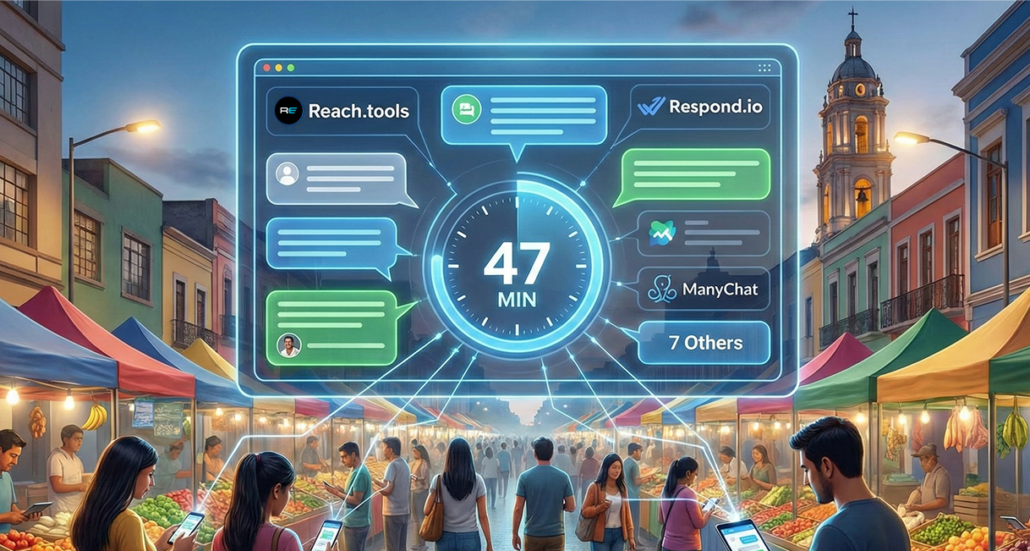

Choosing a Conversational Commerce Platform: An Honest Comparison for Latin American Retail (Reach.tools vs. Respond.io vs. ManyChat vs. 7 Others)
The 47-Minute Sales Killer
Tuesday afternoon, 3 PM. A customer messages your WhatsApp Business asking about your new sneaker collection. Five other conversations demand attention. The message sits unanswered.
Forty-seven minutes pass.
By the time your team responds, the customer bought from your competitor—the one who replied in under two minutes.
This scenario repeats itself hundreds of times every month across retail operations in Latin America. You already know you need a conversational commerce platform. The question isn’t whether. It’s which one.
But here’s the problem with most platform comparisons: they read like feature lists written by people who’ve never lost a sale to slow response times. They don’t tell you when you should pick their competitor. They don’t admit their weaknesses.
Let me be direct: We’re Reach.tools. Yes, we’re one of the platforms you’ll read about here. But this guide will tell you exactly when you should choose us and when you shouldn’t. Because the worst outcome isn’t you choosing a competitor—it’s you choosing the wrong solution and discovering it six months too late.
If you’re comparing platforms, you’re dealing with one of two problems: lost sales from slow responses or suffering customer service from scattered conversations. Let’s figure out which platform solves your specific problem.
The Architecture Question Nobody Asks
Before comparing features, understand one critical concept most articles skip: the difference between omnichannel and multichannel architecture.
Here’s what this means in practice.
A multichannel platform connects WhatsApp, Instagram, Facebook Messenger, and email into one interface. Sounds perfect, right? Except these channels operate in silos. When Maria contacts you via Instagram asking about product availability, then follows up two days later via WhatsApp, the system sees two different Marias. Your agent has no idea you already spoke with her.
An omnichannel platform uses contact merge. When the same person reaches out through different channels, the system recognizes them and consolidates their profile. Your agent sees the complete conversation history across every channel. Maria is Maria, whether she writes via WhatsApp, Instagram, or email.
Why does this matter? Because the average customer in Latin America uses 3.2 different channels to communicate with brands. If your platform can’t connect these dots, you force customers to repeat themselves. You lose context. Your team works harder than necessary.
This architectural difference matters more than any feature list.
Getting Your Size Right
Your team size determines which solutions work for you.
| Team Size | Your Needs | Realistic Platform Options |
| Micro (≤3 people) | Simple, works immediately. No complex features. | ManyChat, Whaticket, Chatfuel |
| Small (3–10 people) | Multi-agent support without enterprise pricing. Scalability matters. | Reach, B2Chat, Kommo, smaller Respond.io setup |
| Mid-market (10–50 people) | Agent management, reporting, volume handling. Growing operations. | Reach, Respond.io, Chattigo |
| Enterprise (50+ agents) | Guaranteed uptime, advanced integrations, support SLAs. | Respond.io, Chattigo enterprise |
Your primary use case matters as much as your size:
| Primary Use Case | What You Need | Best Fit Platforms |
| Customer Support | Strong ticketing, agent assignment, queue management | Respond.io, Chattigo |
| Sales | Catalog integration, payment processing, sales tracking | Reach, Respond.io, Kommo |
| Marketing Automation | Broadcast capabilities, segmentation, drip campaigns | ManyChat, Chatfuel |
| E-commerce Inventory | Real-time stock sync, order management | Avify |
| Everything | True omnichannel, all features | Respond.io (expect enterprise pricing) |
Platform Comparison at a Glance
Here’s the quick overview before we dive into details:
| Platform | Architecture | Starting Price | Ideal Team Size | Primary Strength | Key Weakness |
| Respond.io | Omnichannel | $159/month | 10–100+ | Enterprise reliability, true omnichannel | Learning curve, higher cost |
| ManyChat | Multichannel | Free-$15/month | 1–5 | Easy Instagram/FB automation | Stability issues, email-only support |
| Chatfuel | Multichannel | $24/month | 1–5 | Simple chatbot creation | No web widget, basic AI |
| Kommo | CRM-first | $25/user/month | 3–20 | CRM + messaging native | Dated interface, email isolated |
| B2Chat | Multichannel | $80/month | 5–20 | LATAM focus, affordable | Limited advanced features |
| Chattigo | Omnichannel | $95/month | 20–200+ | Enterprise LATAM provider | Complexity, higher cost |
| Whaticket | Multichannel | $109/month | 3–15 | Budget-friendly, LATAM focus | Limited scalability data |
| ATOM | AI-first | Custom pricing | 20–100+ | Multimodal AI (voice, image) | Long implementation, high cost |
| Avify | E-commerce | $99/month | 3–15 | Inventory sync for retail | Only for e-commerce |
| Reach.tools | Sales-focused | $149/month + $250 setup | 5–50 | Payment integration, LATAM retail | No free trial, setup time (personalized) |
The Platform-by-Platform Reality

Enterprise Omnichannel: Respond.io
Respond.io shows what enterprise-grade conversational platforms look like. They guarantee 99.9996% uptime—your platform down for 20 seconds per month. Many competitors face hour-long outages during peak traffic.
What they do exceptionally well:
- True omnichannel architecture with contact merge across every channel
- WhatsApp voice calls integrated directly in the platform
- Advanced workflow automation handling complex logic
- 24/5 human support in multiple languages, plus 24/7 AI support
The pricing reality: Starts at $159/month for 10 users. Pricing uses Monthly Active Contacts (MAC)—you pay only for contacts you interact with each month, not your total database. For mid-sized retail operations, expect $200–400/month.
Choose Respond.io over Reach when: You run true omnichannel operations where email support, voice calls, and social messaging must unify.You have a technical team that can leverage their advanced automation.
The real weakness: It has a learning curve. Power requires configuration time. Small teams might find it excessive.

Marketing Automation: ManyChat
ManyChat built its reputation on Instagram and Facebook Messenger marketing automation. Their visual flow builder is intuitive. For small businesses doing social media marketing, their free plan actually works.
Their sweet spot: Small e-commerce businesses, influencers, marketers who need to automate Instagram/Facebook engagement. If you’re capturing leads through Instagram comment triggers or Messenger campaigns, ManyChat refined this to an art.
The stability problem: Multiple user reports indicate platform instability when handling high message volumes. Outages during campaign launches have been documented. For a small campaign, this is annoying. For a business relying on messaging as their primary sales channel, it’s a revenue killer.
When it makes sense: Messaging is a marketing channel for you, not your primary sales channel. You’re a small operation (under 5 people) needing something affordable and easy to set up. You’re doing primarily Instagram/Facebook automation.
Why you’ll outgrow it: The architecture is multichannel—conversations don’t unify across platforms. Support is email-only with slow response times. The platform is built for automation, not live agent support at scale.
Pricing: Free plan for up to 1,000 contacts. Pro plan starts at $15/month but scales with your contact list.

Marketing Automation: Chatfuel
Chatfuel mirrors ManyChat—visual chatbot builder, focused on Messenger/Instagram/WhatsApp automation, template-driven approach.
Key differences: No free plan (starts at ~$24/month), but some users find the interface cleaner. The AI is basic—keyword recognition, not natural language processing.
The limitation: No dedicated web chat widget. Channels operate in silos. Better suited for simple FAQ bots than complex sales operations.
Choose it if: You want ManyChat-like capabilities but prefer their interface, and you’re willing to pay from day one.

CRM-First: Kommo
Kommo (formerly amoCRM) is a CRM platform with messaging, not a messaging platform with CRM features. This distinction matters.
When CRM + messaging integration matters: Your sales team lives in CRM—managing pipelines, tracking deals, nurturing leads over weeks—and messaging is how they communicate with those leads. The sales pipeline integration is native and well-designed.
The interface reality: Users consistently report the interface feels dated compared to chat-first platforms. Features feel buried in menus. If you’re used to modern chat interfaces, this will frustrate your team initially.
Price-to-value for sales teams: At $25/user/month with a 6-month commitment, it’s competitively priced for what you get—a full CRM plus messaging. The catch: email conversations remain separate from messaging, fragmenting your customer view.
Choose Kommo when: You need CRM and messaging together, your sales cycle is longer (not impulse purchases), and you’re willing to adapt to a less modern interface.
LATAM Regional Specialists: B2Chat, Chattigo, Whaticket
These platforms share something important: they understand Latin American business operations deeply because they were built here.
| Platform | Base Price | Origin | Best For | Limitation |
| B2Chat | ~$80/month | Colombia | Small Colombian businesses | Limited advanced features |
| Chattigo | ~$95/month | Chile | Mid-to-large LATAM enterprises | Complexity, higher price |
| Whaticket | ~$109/month | LATAM-focused | Essential features only, Spanish/Portuguese | Limited scalability documentation |
The local advantage: These platforms understand LATAM payment methods, business practices, and provide support in local time zones and languages. When regional support matters more than global features, they’re solid choices.

AI-First: ATOM
ATOM plays a different game—they’re betting on sophisticated AI automation as the differentiator.
Multimodal AI capabilities: Their AI agents handle text, voice notes, images, and calls 24/7. A customer can send a photo of a damaged product and the AI analyzes it and initiates a return without human intervention.
Enterprise pricing reality: Not publicly listed, but positioned for mid-market and up. Implementation takes ~2 months on average—not plug-and-play.
When advanced automation justifies cost: You’re in financial services, insurance, automotive, or another sector where queries are complex but follow predictable patterns. You have the volume to justify investment in training the AI.
Choose ATOM over Reach when: AI-driven automation is more valuable to you than payment integration and catalog management. You need sophisticated automation at scale rather than sales-specific AI features.

E-commerce Hyper-Specialized: Avify
Avify does one thing specifically: connects WhatsApp conversations to real-time inventory management for e-commerce.
The inventory integration advantage: When a customer asks about product availability via WhatsApp, Avify syncs with your Shopify store and physical locations. You can create orders, check stock, calculate shipping, and process payments—all from the chat.
Very specific use case: Small to medium retail/e-commerce businesses in Central America that sell primarily through WhatsApp and need to avoid overselling or manual inventory checks.
Limitations beyond e-commerce: If you’re not in retail, or if inventory management isn’t a pain point, Avify’s specialization becomes a limitation. It’s built for one use case and does it well.
Pricing: Starts at $99/month but has complex tiering based on users, order volume, and contacts.

Reach.tools: Where We Fit (Being Honest)
Now let’s talk about where Reach.tools fits. I’m going to tell you our strengths and our weaknesses.
Our Strengths:
| Feature | What This Means for You |
| In-chat payments integration | Customers complete purchases without leaving WhatsApp, Instagram or Facewbook. Native payment processing, not bolted on. |
| Catalog management | Product catalogs sync with your ECommerce. Agents send product cards in conversations. Built for retail selling. |
| LATAM optimization | Meta Business Partner based in Latin America. We understand local payment methods, business practices, operate in local time zones and languages. |
| Sales-focused features | Real-time sales reporting, agent performance tracking, ad conversion analytics. Optimized for teams that sell through conversations. |
Our Honest Weaknesses:
Pay attention to this part:
| Weakness | What This Means for You | Better Alternative |
| Higher initial price | $149/month + $250 setup fee. For small operations on tight budgets, this is a barrier. | ManyChat or Whaticket for getting started |
| No free plan or trial | Can’t test-drive Reach for free. Must commit to demo and paid plan first. | ManyChat for experimenting first |
| Implementation takes longer | Custom setup and onboarding. Better configuration, but not live in 24 hours. | ManyChat or Chatfuel for instant deployment |
| Not ideal for very small ops | Team of 3 or fewer handling minimal volume = paying for capabilities you don’t need yet. | Whaticket or ManyChat until you grow |
When You Should Choose Reach:
✅ Retail or e-commerce operation in Latin America selling heavily via social channels
✅ Payment integration and catalog management would directly impact your sales conversion
✅ Team of 5–50 people (our sweet spot)
✅ Primary goal is sales, not marketing automation or customer support
✅ Message volume is significant enough to justify investment
✅ AI bots will improve your customer’s and team’s experience with each other
When You Should NOT Choose Reach:
❌ Your team is 3 people or fewer—you’re not ready for our price point or complexity
❌ Your monthly message volume is low (under 500 messages/month)
❌ You’re not primarily selling via social channels—if it’s customer support or marketing only, other platforms are more aligned
❌ You need to be operational today with zero setup time—we require implementation
❌ Budget is extremely constrained—good cheaper options exist for getting started
The Pricing Reality
Let’s talk about what these numbers actually mean.
| Platform | Listed Starting Price | Real Cost at Scale (Mid-Sized Team) | Pricing Model | Hidden Costs |
| ManyChat | Gratis-$15/month | $50–100+/month | Contact list size | Scales rapidly with growth |
| Chatfuel | $24/month | $40–80/month | Channel + contacts | Separate channel subscriptions |
| Respond.io | $159/month | $200–300/month | Monthly Active Contacts | Generally predictable |
| Reach.tools | $149/month + $250 setup | $149–200/month after setup | Monthly Users / Features + setup | One-time setup fee |
| Kommo | $25/user/month | $125–250/month (5–10 user) | Per user | 6-month commitment required |
| B2Chat | $80/month | $80–150/month | Tiered features | Add-ons for advanced features |
| Chattigo | $95/month | $150–300/month | Tiered + customization | Enterprise features cost more |
| Whaticket | $109/month | $109–200/month | Users + WhatsApp lines | Custom pricing model |
| Avify | $99/month | $150–300/month | Users + orders + contacts | Complex scaling |
| ATOM | Custom | $300+/month (estimated) | Custom enterprise | Implementation + training |
Hidden costs to watch for:
- Implementation time (are you paying someone to set this up?)
- Training (will your team need support?)
- Add-ons (is WhatsApp API extra? AI features? Payment processing?)
Budget Bands Guide
| Monthly Budget | Realistic Platform Options | What You Sacrifice |
| Under $100 | ManyChat (under 3K contacts), Whaticket, B2Chat, Chatfuel basic | Advanced features, guaranteed uptime, enterprise support |
| $100-$300 | Reach.tools, Respond.io (lower end), Chattigo, Kommo (5–10 users) | Some enterprise guarantees, largest team sizes |
| $300+ | Respond.io (larger teams), Chattigo enterprise, ATOM | Nothing—this is enterprise territory |
ROI Perspective
Here’s what matters more than monthly cost: What’s the value of recovering lost sales?
Example calculation:
- Lost sales per month: 50
- Average order value: $30
- Lost monthly revenue: $1,500
If a $150/month platform recovers 30% of those losses ($450), it pays for itself three times over.
Cost per successful sale conversation is your real metric:
- Platform A: $200/month, 100 sales closed = $2 per sale
- Platform B: $50/month, 30 sales closed = $1.67 per sale but you lost 70 potential sales
Making Your Decision
Here’s your decision framework:
| If Your Situation Is… | Start With These Platforms |
| Team of 3 or fewer, minimal budget | ManyChat (free plan), Whaticket |
| Team of 3–10, growing retail operation | Reach.tools, B2Chat, smaller Respond.io setup |
| Team of 10–50, established operation | Reach.tools, Respond.io, Chattigo |
| Team of 50+, enterprise needs | Respond.io, Chattigo enterprise |
| Primary need: Marketing automation | ManyChat, Chatfuel |
| Primary need: Sales conversion | Reach.tools, Respond.io, Kommo |
| Primary need: Customer support | Respond.io, Chattigo |
| Primary need: E-commerce inventory sync | Avify |
| Need advanced AI automation | ATOM, Respond.io, Reach.tools |
| Under 500 messages/month | Start Small—ManyChat, Whaticket |
| 500–2,000 messages/month | Mid-tier platforms—Reach, B2Chat, Kommo |
| 2,000+ messages/month | Enterprise-ready only—Respond.io, Chattigo, Reach |
Red Flags to Watch
| Red Flag | What It Means | What to Do |
| Platform promises everything | Claims to be best for marketing AND support AND sales AND e-commerce | Look for specialized platforms instead |
| No pricing transparency | Requires “contact sales” before sharing any numbers | Assume enterprise pricing, budget accordingly |
| Email-only support | 48-hour response times via tickets only | Avoid if you need urgent issue resolution |
| Stability complaints | Multiple reviews mention outages during high traffic | Research thoroughly, ask about uptime guarantees |
Your Implementation Checklist
| Step | Action Items | Why This Matters |
| Audit pain points |
Write down specifically what’s broken. Be detailed. | “Losing sales” is too vague. “Customers wait 30+ minutes for responses and abandon” is specific. |
| Project volume | Estimate your 12-month message volume based on current numbers + growth | Determines which pricing models work for you |
| Define must-haves | List non-negotiable features (not nice-to-haves) | Can you survive without payment integration? Without AI? Without voice calls? |
| Test platforms | Use free trials where available. Book detailed demos where trials don’t exist. | Ask about your specific use cases, not generic features |
| Reference checks | Request customer references in your industry and region | Talk to them about real challenges, not just successes |
What Actually Matters
The goal isn’t finding the “best” platform in some abstract sense. It’s finding YOUR platform—the one that solves your specific problems at a price you can justify.
Every lost sale because a customer waited too long for a response has a real cost. Every frustrated customer who had to repeat their information across channels has a real cost. Every hour your team spends juggling five different apps instead of having one unified inbox has a real cost.
Making an imperfect decision and implementing it beats eternal research. You can switch platforms if needed. You can’t recover the sales you’re losing today while you delay.
Here’s what we’ve learned from working with retail operations across Latin America: The platforms that win aren’t the ones with the longest feature lists. They’re the ones that match their customers’ actual needs. Figure out your needs first, then choose your platform.
If you’re a retail operation in Latin America selling through social channels and you think Reach’s feature set aligns with your needs, [book a demo here]. If we’re not the right fit, I hope this guide helped you figure out who is.
The conversational commerce space in Latin America is exploding. Take advantage of the opportunity by implementing the right platform today.
Insights & Trends